Leander Independent School District has launched a long-range planning process intended to guide decisions about programs, staffing, facilities and financial sustainability through 2037.
Trustees received an introduction to “Leander ISD 2037” at their September 3 meeting. The district says the process will combine data with community input and does not begin with predetermined solutions.
Civic Solutions Group is facilitating the work. Students, employees, parents, advisory groups, civic organizations and other community members are expected to be invited into multiple stages of engagement.
Why the district is planning now
LISD points to changing enrollment, financial pressure and evolving student needs. District information says kindergarten enrollment fell by about 300 pupils from 2025 to 2026, while its demographer projects total enrollment could decline to 38,000 or lower during the next decade.
Those changes are not uniform. Some neighborhoods continue to grow while others are seeing fewer students, creating different pressures across campuses. Larger classes are also graduating while smaller groups enter the system.
Possible areas for later analysis include staffing, programs, revenue, facilities, campus use and spending. These are topics for evaluation, not an announced closure list or a set of approved cuts.
How community input fits
Initial advisory-group conversations began September 10. The district plans a ThoughtExchange by the end of September, with feedback continuing through October and November.
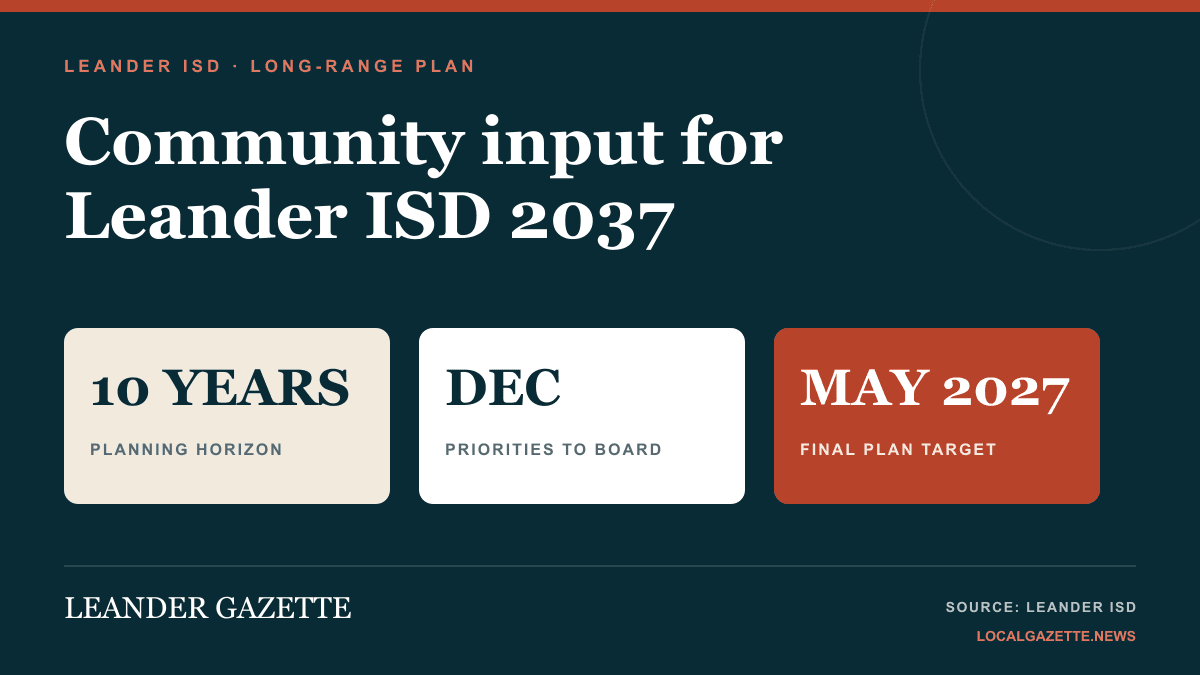
Proposed long-term priorities are expected to reach trustees in December. From January through May 2027, the district and its facilitator plan to develop scenarios, conduct financial and operational analysis, and seek another round of public input.
The eventual work is expected to produce shared priorities, a ten-year roadmap, criteria for future decisions, and scenarios or recommendations. Trustees will vote on the final plan.
Campus overviews are also planned for every LISD school. The district says they will bring relevant data together, identify sources and definitions, and be available in multiple languages and formats.
Residents should use official district channels for engagement dates because the September launch article describes a schedule that may be refined. Comments on social media may inform discussion but are not necessarily part of the formal record.
What families can contribute
District data can show enrollment, building use and financial trends, but community feedback can explain how those changes affect students in practice. Families may want to comment on access to programs, travel between home and school, class sizes, special education, extracurricular opportunities and the role a campus plays in its neighborhood.
Students and staff can add detail about schedules, learning spaces, support services and operational problems that are difficult to understand from district-wide totals. Residents without children currently enrolled can still contribute views about long-term community needs and the use of public assets.
Constructive feedback is most useful when it identifies a priority and the trade-off behind it. Wanting every service preserved while reducing cost, for example, creates a tension the planning process will have to address. Participants can ask what evidence will be used, how alternatives will be compared and how the district will report disagreement.
Key stages to watch
The first stage is priority-setting through the end of 2026. The second stage, planned for January through May 2027, moves from broad priorities to scenarios, detailed analysis and recommendations. A proposal discussed during engagement is not final unless trustees later approve it.
Campus overviews will be important because district-wide enrollment trends can mask significant differences between schools. Readers should look for consistent definitions, the date of each dataset and explanations of capacity, attendance boundaries and program use.
Families should keep copies of substantive responses they submit and watch for district summaries showing how input was grouped or used. Formal meeting notices, board documents and the dedicated planning channels will provide a stronger record than second-hand posts. The Gazette will distinguish consultation ideas from adopted decisions in later reporting.
The rationale, timeline and stated outcomes are explained in the official Leander ISD 2037 announcement.